


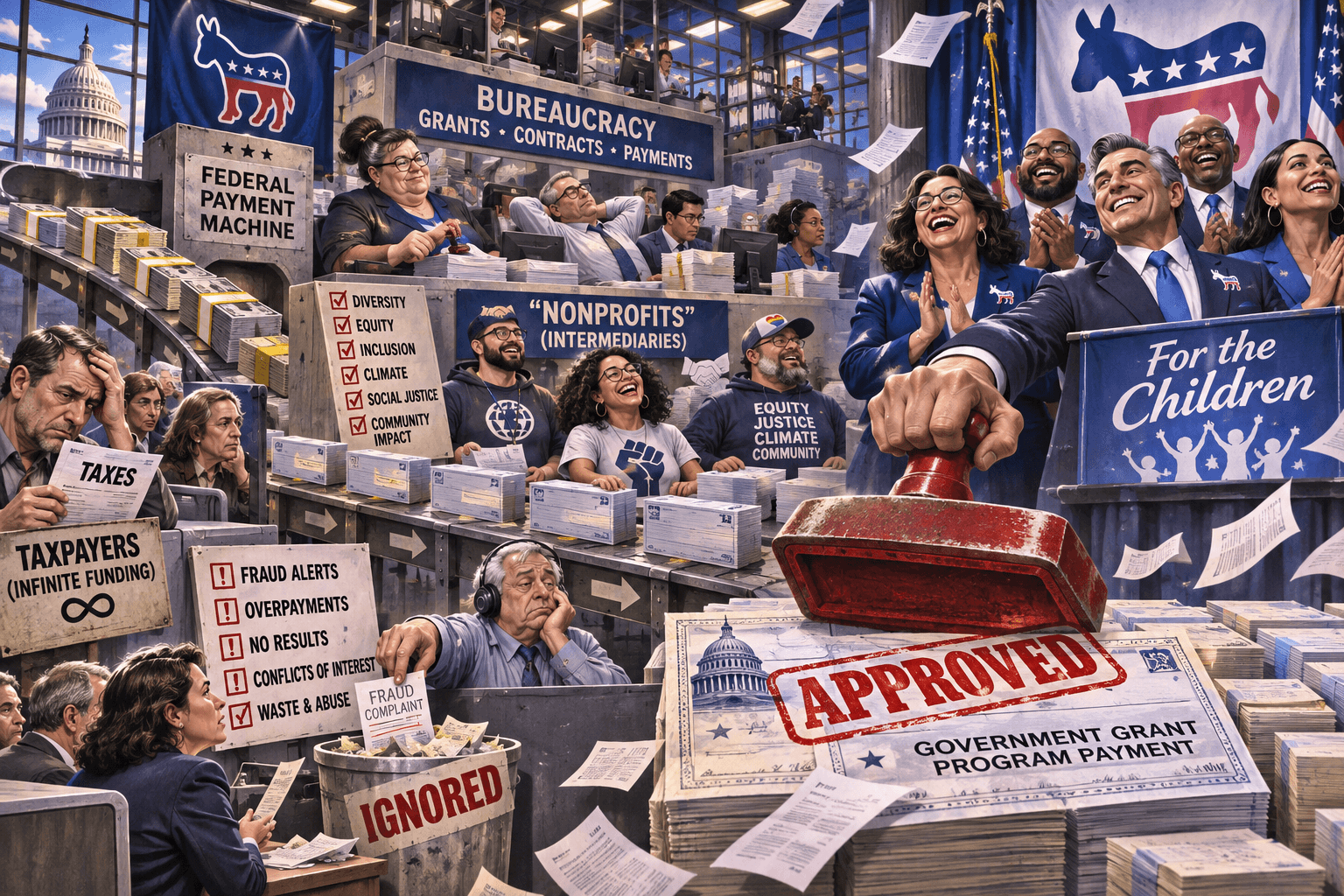
“The thief owns the theft. The institution owns every check written after the warning.”
Minnesota’s Department of Education received at least 30 complaints involving Feeding Our Future, the nonprofit at the center of a $250 million child-nutrition fraud scheme. Some complaints weren’t investigated. Others were handled so poorly that state officials actually asked Feeding Our Future to investigate complaints about Feeding Our Future.
The honor system needed an honor system?
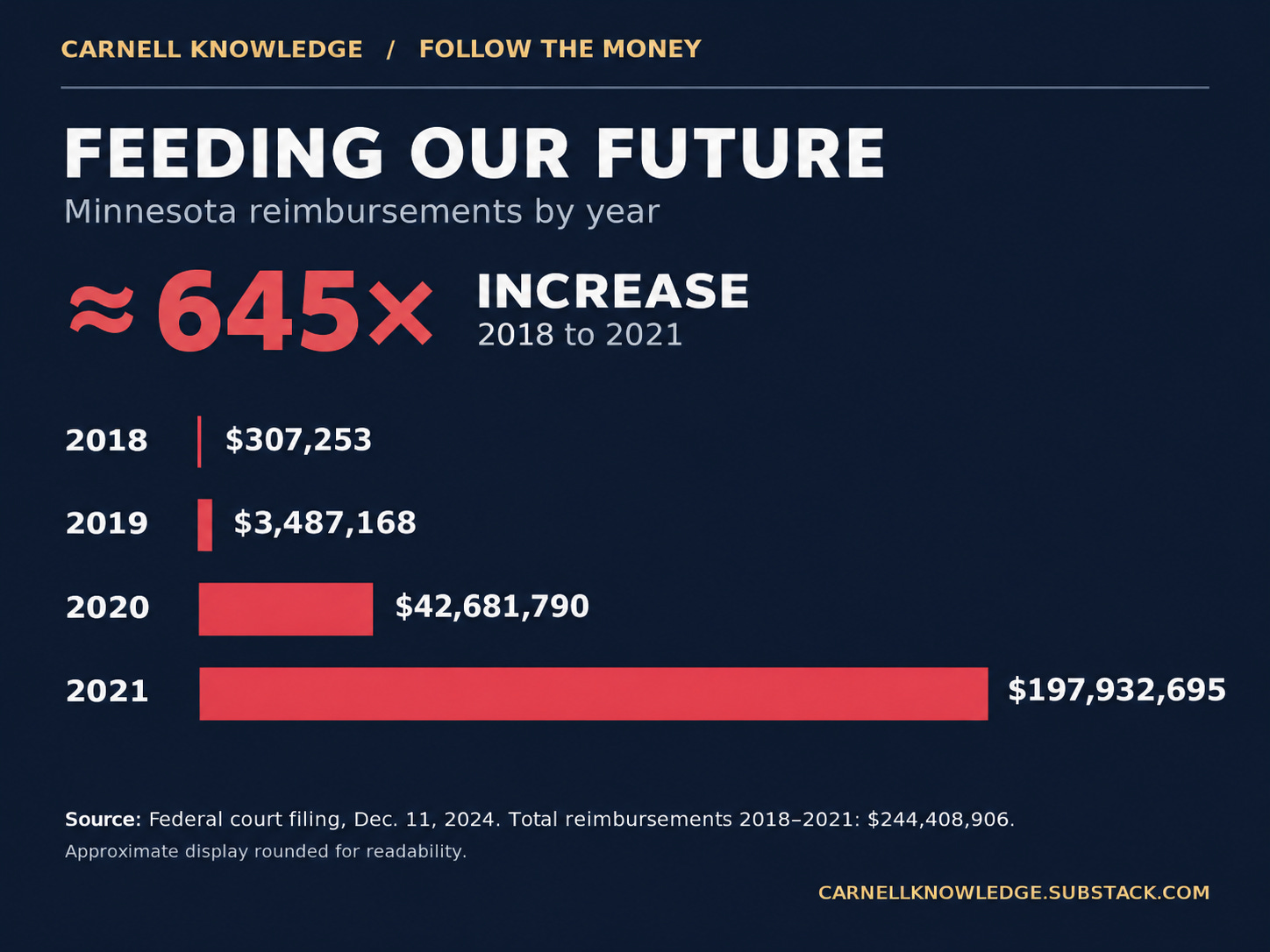
In 2018, Feeding Our Future received just $307,253 in federal child-nutrition reimbursements. By 2019, that figure had jumped to $3.5 million. In 2020, it exploded to $42.7 million. And in 2021, it reached nearly $198 million.
That’s a 645-fold increase in just three years, while Minnesota officials were receiving complaints about the organization.
Apparently, Minnesota had discovered the world’s hungriest children. Or the world’s most profitable paperwork.
Federal investigators eventually uncovered fabricated attendance records, bogus invoices, shell companies, and an operation that converted money intended to feed children into private fortunes.
The people behind the fraud weren’t anonymous. Most of the 81 defendants charged by late October 2026 were Somali Americans. Feeding Our Future’s founder and executive director, Aimee Bock, was white and played a central role in the operation. She received 41 years and eight months in federal prison. Salim Said, the Somali-born operator of Safari Restaurant, received 30 years. Abdiaziz Shafii Farah, whose network falsely claimed to have served millions of meals, received 28 years for his role in the fraud.
These weren’t accounting mistakes. Prosecutors established that participants fabricated meal counts, falsified invoices, laundered money, and enriched themselves through a program intended to feed poor children. Farah was also convicted of involvement in an attempt to bribe a juror during his federal trial.
The state’s legislative auditor reached a devastating conclusion: Minnesota’s Education Department had failed to act on warning signs that existed even before the pandemic. Its inadequate oversight had created opportunities for fraud.
This happened under Democrat Governor Tim Walz, whose administration was responsible for overseeing the state agencies administering these programs.
And Feeding Our Future was hardly Minnesota’s last encounter with government-funded fraud.
The Paperwork Is the Product
Minnesota established a Medicaid program to help vulnerable people find and maintain housing. Officials initially estimated annual costs of approximately $2.6 million. By 2024, the program was paying out $104 million.
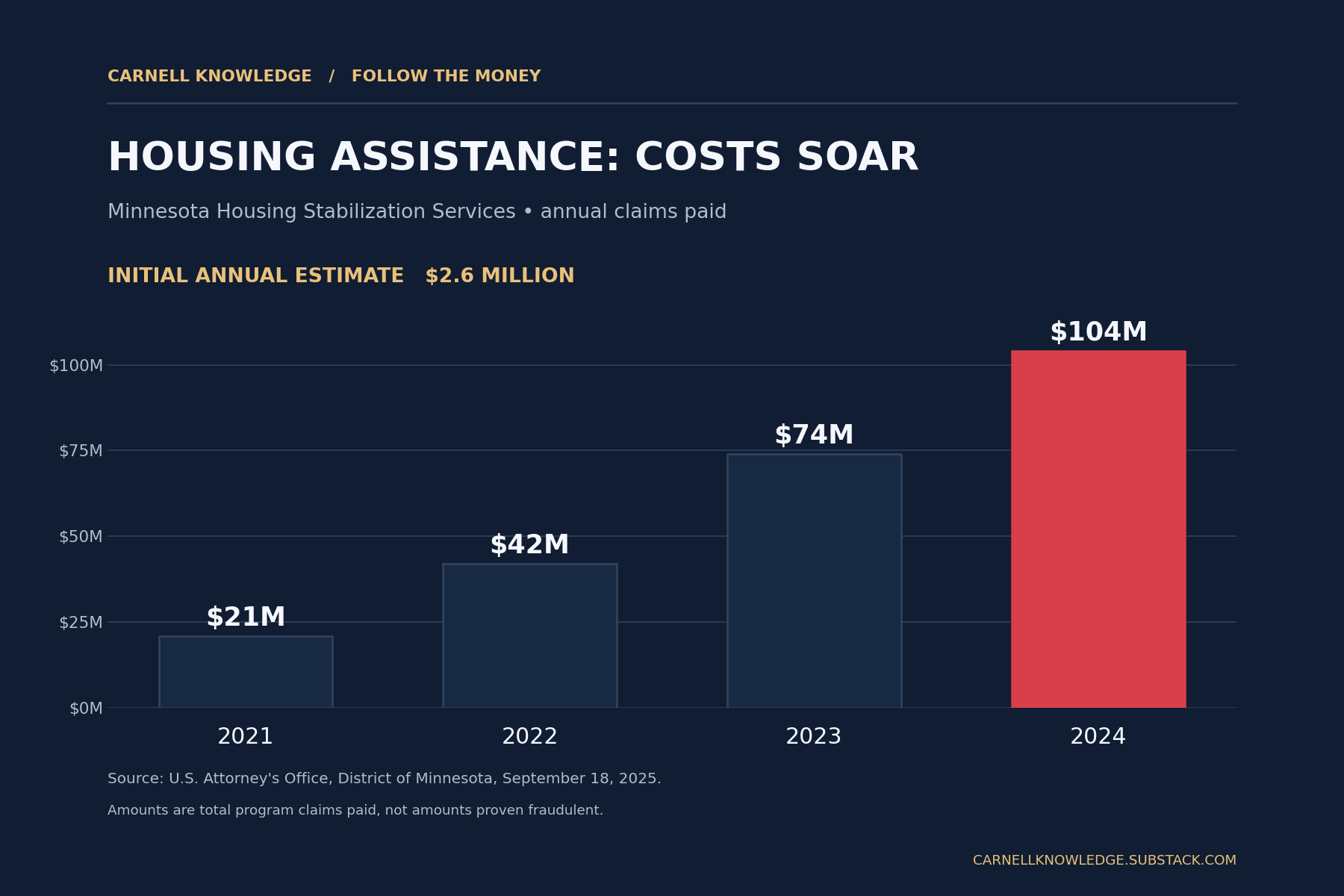
That’s quite an increase for a program that wasn’t actually buying anybody a house.
Housing Stabilization Services reimbursed providers for helping people locate housing, prepare applications, and maintain stable living arrangements. Unlike purchasing a house, however, purchasing an hour of assistance leaves government with little physical evidence that anything happened.
A provider submits the claim. Government processes the paperwork. Taxpayers pay the bill.
Federal prosecutors eventually uncovered schemes involving fabricated services, inflated claims, and providers collecting substantial sums for work they hadn’t performed as billed. The program’s minimal documentation requirements and low barriers to entry made it particularly attractive to fraudsters.
In other words, Minnesota built a payment system that depended heavily on trusting the people requesting payment.
Feeding Our Future demonstrated how badly that arrangement can fail. So did the housing program. Sometimes the paperwork is the only thing that exists.
Childcare subsidies raised their own questions about Minnesota’s regulators. Quality Learning Center in Minneapolis accumulated 121 licensing violations between May 2022 and June 2025, including problems involving child supervision, safety requirements, and recordkeeping. Regulators placed its license on conditional status in 2022 because of serious and repeated violations.
Yet the facility continued receiving public money, including approximately $1.9 million in childcare assistance during fiscal 2025.
When a viral investigation drew national attention to the center in December 2025, state officials initially gave conflicting accounts of whether it had closed. Inspectors subsequently found children present, and licensing records showed no established fraudulent billing. The center ultimately closed in January 2026.
So the documented scandal here isn’t a proven phantom daycare. It’s a childcare operation that accumulated an extraordinary record of licensing violations while taxpayers continued financing it. The question for Minnesota’s regulators is why a facility with that compliance history remained eligible for substantial public payments, and whether the corrective actions they accepted adequately protected the children and the taxpayers.
That’s the problem with examining government programs only after criminal investigators arrive. By then, discovering whether a provider actually delivered what taxpayers purchased can be extraordinarily difficult.
The Number Nobody Puts in the Headline
When prosecutors announce a $250 million fraud, everybody focuses on the $250 million. I want another number.
How much money went out after somebody inside government had credible reason to suspect something was wrong?
I call that Loss After Notice.
Minnesota’s legislative auditor documented complaints, inadequate investigations, and repeated failures to exercise enforcement authority available to the Education Department.
We don’t need new regulations or laws. Just enforce the ones we have and hold people and companies accountable.
The department blamed federal restrictions and pandemic-era changes for some of its difficulties. Yet the auditor found significant warning signs predating COVID-19.
Feeding Our Future also sued the state and alleged discrimination amid its disputes with regulators. Enforcement was complicated, and challenging a provider could mean dealing with lawyers, complaints, and political controversy.
Consider the incentives. A dishonest provider wants to keep collecting money. A politician wants his program to appear successful. An agency wants to avoid controversy. And the employee questioning suspicious claims may discover that approving another payment creates fewer immediate headaches than demanding proof.
The fraudsters understood something about government that taxpayers apparently weren’t supposed to notice: It was easier to keep collecting the money than it was for the bureaucracy to stop paying it. Minnesota’s legislative auditor documented warnings that officials failed to investigate adequately, even as the reimbursements kept growing.
Meanwhile, politicians enjoy the credit for expanding services. They announce funding, cut ribbons, celebrate beneficiaries, and describe their expenditures as investments in the community.
When fraud investigators uncover what happened to those investments, responsibility suddenly becomes a complicated matter involving federal regulations, departmental procedures, and somebody else’s signature.
Funny how readily politicians accept credit and how difficult it becomes to locate responsibility.
The Democrat Party has been a leading champion of expanding government benefits and grant-funded services. The more money that travels through providers, contractors, and nonprofit intermediaries, the more important independent verification becomes.
And if the politicians who promote these programs want credit for helping people, they should be prepared to answer for the failures of the institutions responsible for delivering that help.
The criminals submitted false claims. Who examined those claims? Who received the complaints? Who decided the warnings weren’t serious enough to stop another payment?
That’s where the next investigation should begin.
The Government Gravy Train
Criminal fraud isn’t the only way government can turn public money into an arrangement that deserves closer scrutiny.
Consider state lotteries.
Americans purchased approximately $104.7 billion in lottery tickets during fiscal 2024. About $70.2 billion went back to players as prizes, leaving roughly $34.5 billion in net lottery revenue.
Quite a business for governments whose politicians frequently complain about private companies profiting from financially vulnerable consumers.
The state advertises jackpots and smiling millionaires while reminding everybody that lottery revenue helps schools and other worthy causes. The advertisements rarely dwell on the millions of losing tickets that make the operation profitable.
The winner is the advertisement. The loser is the business model.
Someone with plenty of money can treat a lottery ticket as entertainment. Someone struggling to pay rent may see it as a chance to escape a financial situation that ordinary work seems incapable of fixing.
Then there’s the education pitch. Lottery money earmarked for schools doesn’t necessarily produce an equivalent increase in education spending. Depending on the state’s budgeting choices, it can replace funding that would otherwise come from general revenue.
The lottery dollar goes in. Another budget dollar comes out. Politicians still congratulate themselves for helping the children. And you can bet those dollars that come out have fewer restrictions attached.
Government has found a remarkably profitable way to take money from people who can least afford to lose it, advertise the occasional winner, and congratulate itself for helping the children. Imagine the outrage if a private company ran the same operation and called it a public service.
When Government Money Becomes Political Money
USAID provides another example.
Americans associate foreign assistance with food, medicine, disaster relief, and fighting disease. But USAID also funded media organizations, political participation, civic advocacy, and efforts to influence how foreign societies are governed.
In USAID and Abet, I examined six usable fiscal-year datasets from government foreign-assistance records and identified approximately $2.5 billion in obligations to nongovernmental organizations across seven political and civic categories. That amounted to roughly 1.7% of obligations in those files. Obligations are commitments to spend, not necessarily completed payments.
A 2014 USAID toolkit discussed training LGBT political candidates and helping political parties incorporate LGBT rights into their platforms. It mentioned progressive parties, including Greens and Social Democrats.
American taxpayers weren’t simply purchasing medicine or feeding starving families. Some of their money was financing political and social objectives overseas.
Funds often passed through large contractors, nonprofits, regional partners, and additional recipients. Every layer added another obstacle for taxpayers trying to understand precisely where their money went.
A 2019 inspector general audit identified weaknesses in safeguards against political bias, although it found no instances of partisanship affecting the programs reviewed.
Republicans have controlled the White House and Congress at various times, but changing political leadership doesn’t automatically change the bureaucracy beneath it. Career officials remain, established contractors continue collecting payments, and nonprofit networks can carry on pursuing priorities established under previous administrations. A study of federal personnel from 1997 through 2019 found that Democrats make up a plurality of federal civil servants, particularly at senior levels.
That’s part of why I believe liberal policies can survive Republican administrations more easily than Republican reforms survive the institutions charged with implementing them. Trump finally forced a confrontation with that machinery. Beginning in 2025, his administration dismantled USAID’s existing structure, terminated thousands of foreign-assistance awards, and transferred its remaining programs to the State Department.
Whatever one thinks of Trump’s methods, the scale of those changes exposed just how much taxpayer money had been committed to programs most Americans had probably never heard of, much less approved.
If government can finance foreign political advocacy, taxpayers ought to know whose priorities are being advanced and what they’re getting for their money.
Who Kept Writing the Checks?
Minnesota’s fraud scandals reveal the danger of paying providers for services government struggles to verify. The lottery illustrates how a government can defend a lucrative revenue operation by pointing to sympathetic beneficiaries. USAID shows how public funds can travel through extensive networks pursuing objectives that go well beyond straightforward humanitarian relief.
The Minnesota cases are the clearest indictment of failed government oversight.
Tim Walz’s administration presided over agencies whose responsibilities included preventing improper payments, investigating complaints, and protecting taxpayer money. Federal prosecutors pursued the criminals, while the legislative auditor documented serious oversight failures.
It’s easy for politicians to promise another billion dollars for education, housing, childcare, or some other worthy purpose. It’s considerably less glamorous to explain how the public will know whether the promised services were actually delivered.
That responsibility doesn’t disappear because a program has compassionate intentions. Nor should it be delegated so thoroughly that nobody can explain why payments continued after credible warnings.
I want to know who received those warnings, who had authority to intervene, what they did, and how much money taxpayers lost while officials were deciding what to do.
Finding the thief is only half the investigation.
The other half begins when the government knew.
The Original Essays
The Quality Learning Center Scam
Help Keep Carnell Knowledge Going
If you appreciate these condensed investigations, consider supporting my work. Your contributions help me continue researching, writing, and publishing independent commentary.
Become a paid subscriber:
https://www.carnellknowledge.com/subscribe?plan=monthly
Become a founding member:
https://www.carnellknowledge.com/subscribe?plan=founding
Buy Me a Coffee:
https://buymeacoffee.com/mrchrisarnell
Less reading, plenty to think about.