


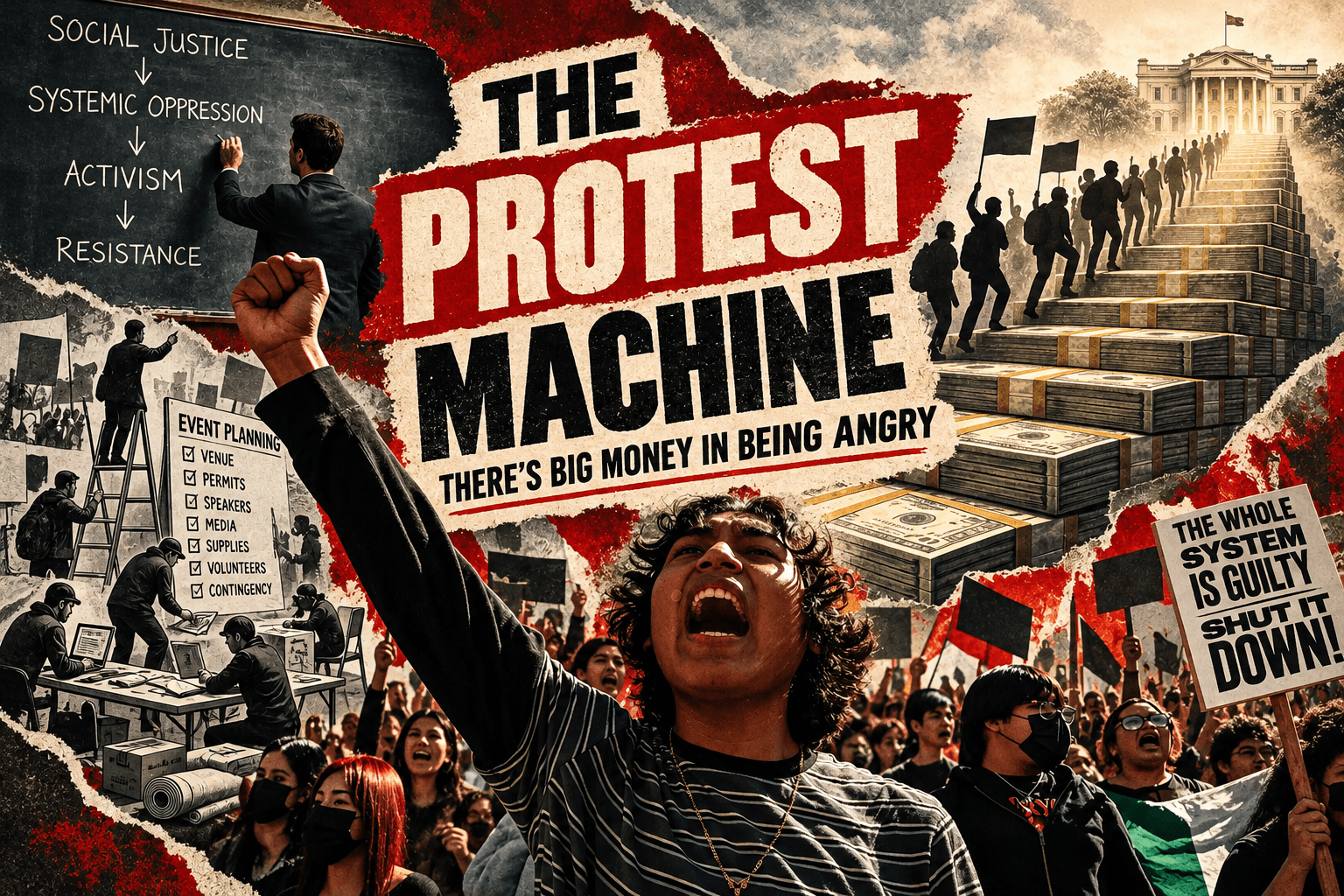
“For most Americans, protesting is something they do when they're angry. For an entire industry of professional activists, keeping people angry is how they make a living.”
While thousands of Americans were marching against Donald Trump this weekend, organizers of a No Kings rally in Kansas City had already scheduled what would happen afterward. The protest was set for 1 p.m. By 2, they planned to have participants knocking on doors, preparing phone banks, distributing voter information, and encouraging people to vote in November.
Apparently, saving democracy comes with a campaign schedule.
I’ve always been curious about how these demonstrations work. Something happens in Washington, a politician makes a controversial statement, or somebody gets arrested, and suddenly there are protests in dozens of American cities. Sometimes hundreds. The slogans are remarkably similar, the messaging is consistent, and the logistics seem to fall into place almost overnight.
Back in March, I spent considerable time researching this and wrote four essays examining what I called The Protest Machine. I followed the organizations involved, where activists learn their trade, the money supporting them, and the people who make a living keeping everything running.
Some of what I found was pretty revealing.
From College Campus to Career
My first essay, Protest U, examined how college campuses have become training grounds for political activists.
A surprising amount of political organizing begins on college campuses. Student organizations recruit supporters, coordinate demonstrations, work with outside advocacy groups, and teach young activists skills that translate rather nicely into professional employment.
In 1967, the University of Chicago published its famous Kalven Report, arguing that universities should provide an environment where competing ideas could be debated without the institution itself taking political sides. Students were supposed to learn how to think, rather than be instructed what to think.
That principle has taken quite a beating.
A 2023 survey by the Foundation for Individual Rights and Expression found that roughly one in ten college students reported being disciplined or threatened with discipline by administrators over something they expressed. Whatever happened to universities being places where people could disagree?
Meanwhile, students interested in political activism can gain practical experience recruiting participants, organizing campaigns, and applying public pressure. Some eventually move into nonprofit internships, paid organizing positions, and political campaigns.
An activity that once competed with studying for exams can become a career, and there’s a surprisingly well-developed industry waiting to employ them.
The Business of Political Outrage
Consider the Center for Popular Democracy, a progressive advocacy organization whose work includes community organizing and political mobilization.
According to its 2024 IRS filing, the organization reported $40.9 million in revenue and $31.8 million in expenses. It employed approximately 125 people, and its co-executive directors received salaries approaching $200,000.
That’s a substantial operation, and it’s only one organization within a much larger network of foundations, nonprofit groups, donors, and advocacy organizations.
My second investigation, Cla$h App, examined how that financial infrastructure works.
One particularly interesting arrangement is called fiscal sponsorship. Instead of forming an independent nonprofit, a qualifying project can operate through an established organization that provides the legal structure, accounting, payroll, regulatory oversight, and administrative services.
The Tides Center, for example, says it supports more than 130 projects and has sponsored over 1,400 during its history. It generally charges projects 9% of their annual revenue for its services.
Imagine trying to launch a new advocacy campaign. You need money, employees, legal compliance, financial systems, and communications. Building all that from scratch takes time and considerable expense.
With fiscal sponsorship, much of the administrative machinery already exists. You still need funding and approval, but you don’t have to reinvent the organization.
Foundations can finance long-term advocacy, professional employees can maintain contact lists and organizing networks, and projects can operate within established institutions. You don’t have to pay thousands of people to carry signs when you can finance organizations that know how to recruit them.
In Protest Inc., my third investigation, I looked at the people who turned political activism into a profession, along with the salaries, budgets, and incentives that keep the industry running.
Now think about what happens when political activism becomes somebody’s livelihood.
An organization with employees, offices, programs, and an annual budget has an incentive to remain in operation. Its leadership needs to demonstrate results to donors and supporters. Demonstrations provide publicity, help recruit participants, and give organizations a way to demonstrate their influence.
If your livelihood depends on fighting a particular problem, what happens when that problem gets solved? Going out of business probably isn’t the first thing that comes to mind.
For the average protester, Saturday’s march may be an afternoon of political expression. For the professional organizer, it’s part of a full-time job, with another campaign already waiting.
Press Button. Receive Protest.
My fourth essay, Insta-Agitator, examined how quickly these networks can mobilize.
Following George Floyd’s death in 2020, researchers documented more than 7,750 Black Lives Matter-related demonstrations across over 2,440 locations between late May and August.
That’s an extraordinary amount of activity, but organizing becomes considerably easier when you’ve already spent years developing the infrastructure.
Modern advocacy groups maintain local chapters, email lists, volunteers, communications staff, social media accounts, and relationships with other organizations. When something happens, they have the means to reach supporters and organize events without starting from scratch.
As I wrote in March, spontaneity rarely has a printing budget.
The No Kings demonstrations this October offer another example of organized political mobilization. Their organizers have explicitly encouraged voter participation ahead of the midterms, and in Kansas City, the schedule moved directly from a rally into voter outreach.
The signs may say No Kings, but the organizers have a more practical objective than spending an afternoon shouting at Donald Trump. They’re trying to influence what happens on Election Day.
Next time you watch a nationwide demonstration, spend a few minutes looking at the organizations involved. Check their websites, leadership, financial filings, and political activities. You might discover that the most interesting people at a protest aren’t necessarily the ones carrying signs.
They’re the ones who’ll still be working when the cameras leave.
Want to Dig Deeper?
This article condenses four investigations I published in March 2026. Together, they examine how modern political activism is developed, financed, staffed, and mobilized.
1. Protest U: How Universities Train Our Kids to Hate America
How campus politics, academic incentives, and student activism can create pathways into professional political organizing.

2. Cla$h App: How Foundations and NGOs Finance the Protest Machine
A closer look at the nonprofit structures, philanthropic foundations, and financial arrangements that support advocacy campaigns.
3. Protest Inc.: How Activism Became a Career Path
The salaries, organizational budgets, and incentives behind an industry most Americans rarely think about.
4. Insta-Agitator: How Protests Are Deployed at Scale
How existing communications networks and professional organizing allow demonstrations to spread rapidly across the country.
All four essays are free to read.
Less Reading, Plenty to Think About.
Carnell Knowledge takes my longer investigations, boils them down into something you can read over coffee, and connects them to what’s happening today.
If you learned something, subscribe and share this article with someone who might find it interesting. Everything here is free, including the hundreds of original essays at mrchrisarnell.com.
If you’d like to help keep the research and writing going, consider becoming a paid subscriber. It’s entirely optional, but the support is appreciated.
Read for free. Share freely. Support if you can.
Brain not to scale.